Showing posts with label assessment. Show all posts

Friday, January 11, 2013

Transforming Minds

Happy New Year! Even though I say I am not going to, it seems like every year I get sucked into some type of resolution. I start out with good intentions and usually somewhere around March realize I had gotten off track.

A couple of years ago, I started my class blog  as a New Year's goal. It has been my most successful New Year's venture to date. I find the documenting of student growth and work to be a great reflective tool for myself and something my students enjoy as well. That is why I was excited to spend my first Saturday of the year with Art teachers in Oakland Schools, talking about technology, assessment, and how they can work together in the Visual Arts classroom to meet a variety of needs.

Claudia Burns also presented at the Transforming Minds conference on the topic of assessment. Her helpful resources will soon be available on the MAEA website.
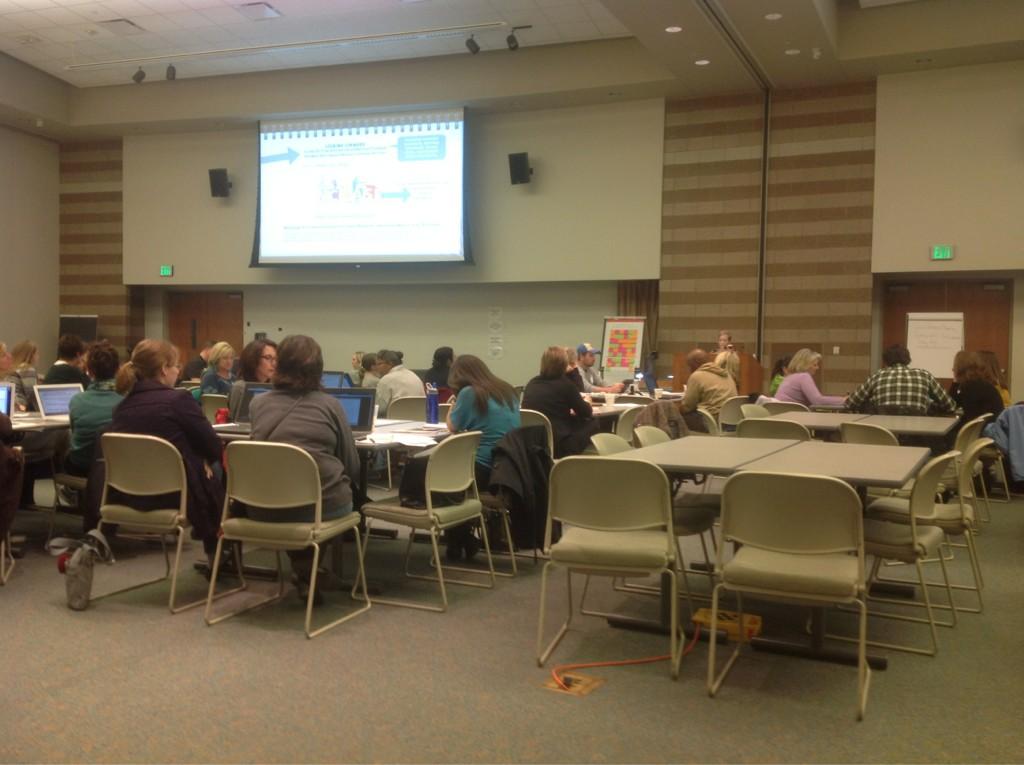
Claudia Burns presented at the January 5th conference in Oakland on the topic of Assessment.

As we move into 2013, the topic of assessment is going to be more and more prevalent. We have to figure out how we are going to document student growth that will be put towards our evaluations. Claudia has really helped get the conversation going, by providing examples of assessment tools and sample assessments that could be used in the classroom. I hope to add to the conversation by providing examples of how the use of technology can aide in our effort with documenting student growth through my collaboration on this blog and others.

In addition to blogging, I also document the efforts in my classroom through Artsonia. This online gallery offers teachers a place to house digital images of student work over the course of their schooling career. Imagine being able to have students go back after years and reflect on their progress in various aspects of art making. I also use Google Forms and Moodle to create tests that help me quickly assess student knowledge, without having to spend time manually grading them. If you are interested in learning about any of these tools, you can find me at the January 19th Flip Teaching Conference at Byron Center High School. The event is free and lunch is provided - what more can I say!

If you are interested in helping shape the future of Assessments in the Arts in Michigan, you can apply to participate in the Michigan's Model Arts Education Instruction and Assessment Project. The deadline for application is January 21st.

What are some ways you are using assessment to document student growth. What are some tools available that help you show student growth?


Thursday, June 14, 2012

Flipping Assessment

Over the course of the past year, there has been much discussion on flipping instruction, moving more resources online for students to access, and really changing the way teachers connect with kids through technology in the classroom. But what if we do more than just flip instruction? Recently I came across this tweet from a consulting firm that also applies to education:

Often times when teaching, we are putting on a performance that tries to engage students in new concepts, skills, and ways of thinking. Unfortunately, as dynamic as that performance may be sometimes just because we did it doesn't mean it reached all students. One idea I think is interesting in addressing this issue is the concept of flipping assessment. Instead of solely focusing on assessing students through projects, tests, and quizzes, turn the tables and have students assess how you are reaching them as a teacher.

This is something I have done informally on the last day of class so I can adjust and reflect on my performance as a teacher. Students write a response to the following: 1. What was something that I should change for next year? 2. What is something that should definitely stay the same?

Sometimes there are responses like "you shouldn't mark us down if we didn't bring in a project" or "you should let us sit with our friends all of the time" which is unlikely to be something that can always change, but often there are direct and pointed critiques of how lessons are taught and what could have been done differently to help them learn the topic more. It is also nice to receive the feedback on what went well. It helps you get an idea on what made the biggest impact on students and think about the circumstances surrounding the projects or lessons to make that so.

For my Digital Arts Camp, I tried a different approach. I used a Google Form to create a survey of why students participated in the camp, what they thought about the camp, and what could be done in future camps to make it a success. By using a Google Form, I am able to compile data and use that data to drive future decisions. This is a great tool to consider using in the beginning of the school year to create student interest inventories or types of learning styles. You could also use it throughout the school year to check in on student attitudes and feelings about the class. Because you can make responses anonymous, it allows students to freely divulge their opinions.
Google Form compiled responses to why students signed up for camp.

 What do you think about being assessed by your students? Do you already do something like this in your classroom and how has it changed your delivery of instruction? Please share all related insights in the comments below.


Sunday, November 13, 2011

Swimming Upstream

We're back from the Conference! So many ideas and images are swirling around in my head. The sounds and sights and wonderful experiences of the weekend energize and sustain us through the winter. I can't wait to try out the new bookmaking techniques I learned and experiment with some watercolors and life drawing with my alternative-ed high school students.

But what I'm really eager to try out are some of the new assessment strategies I've been reading about. Really?

I know, it's not media, it's kinda left-brained, it doesn't seem very "arty." But we can use quality assessment to improve instruction and empower students. And, learning how to assess students very well might save your job.

The number of stories I heard this weekend about teacher evaluation, assessment, about "My district is expecting this..." was surprising. But the work has begun and it looks like Walled Lake and Ann Arbor are leading the way. In their workshops Walled Lake and Ann Arbor teachers (and one administrator) described the innovative curriculum that they have been developing over the last few years.

What are you doing in your district? Have your administrators challenged you to validate your art program? How do you use assessment? This is a challenging area for some of us; let's help one another out. Let's swim upstream together.