Showing posts with label cross-curricular. Show all posts

Friday, January 11, 2013

Transforming Minds

Happy New Year! Even though I say I am not going to, it seems like every year I get sucked into some type of resolution. I start out with good intentions and usually somewhere around March realize I had gotten off track.

A couple of years ago, I started my class blog  as a New Year's goal. It has been my most successful New Year's venture to date. I find the documenting of student growth and work to be a great reflective tool for myself and something my students enjoy as well. That is why I was excited to spend my first Saturday of the year with Art teachers in Oakland Schools, talking about technology, assessment, and how they can work together in the Visual Arts classroom to meet a variety of needs.

Claudia Burns also presented at the Transforming Minds conference on the topic of assessment. Her helpful resources will soon be available on the MAEA website.
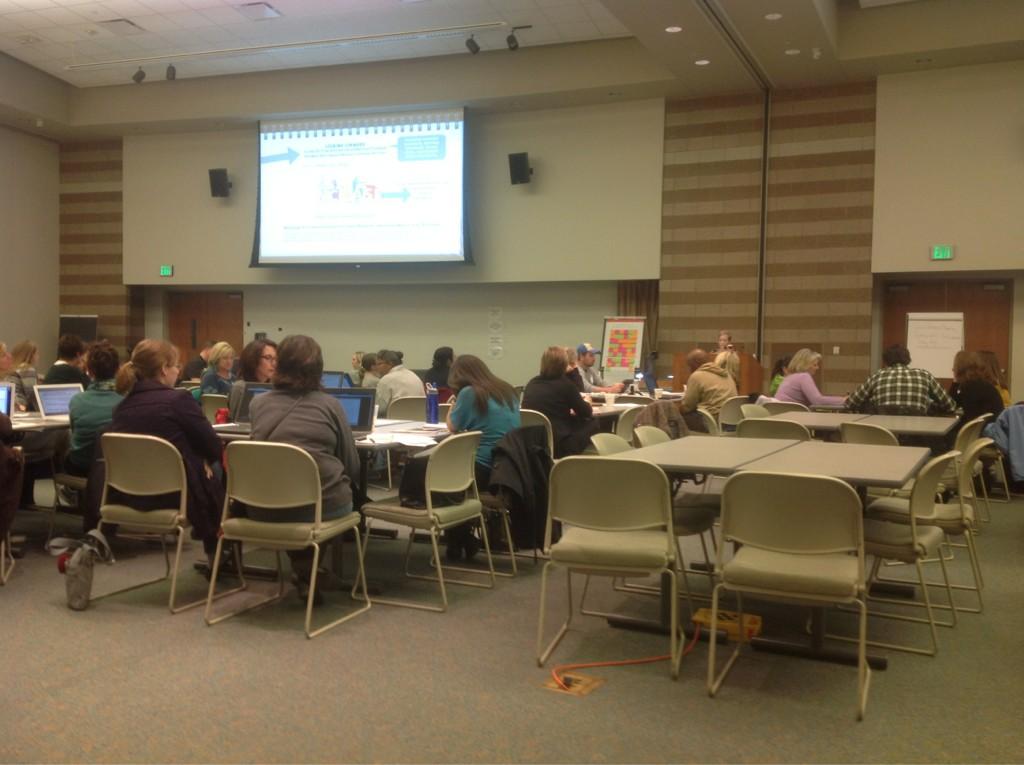
Claudia Burns presented at the January 5th conference in Oakland on the topic of Assessment.

As we move into 2013, the topic of assessment is going to be more and more prevalent. We have to figure out how we are going to document student growth that will be put towards our evaluations. Claudia has really helped get the conversation going, by providing examples of assessment tools and sample assessments that could be used in the classroom. I hope to add to the conversation by providing examples of how the use of technology can aide in our effort with documenting student growth through my collaboration on this blog and others.

In addition to blogging, I also document the efforts in my classroom through Artsonia. This online gallery offers teachers a place to house digital images of student work over the course of their schooling career. Imagine being able to have students go back after years and reflect on their progress in various aspects of art making. I also use Google Forms and Moodle to create tests that help me quickly assess student knowledge, without having to spend time manually grading them. If you are interested in learning about any of these tools, you can find me at the January 19th Flip Teaching Conference at Byron Center High School. The event is free and lunch is provided - what more can I say!

If you are interested in helping shape the future of Assessments in the Arts in Michigan, you can apply to participate in the Michigan's Model Arts Education Instruction and Assessment Project. The deadline for application is January 21st.

What are some ways you are using assessment to document student growth. What are some tools available that help you show student growth?


Wednesday, August 15, 2012

Mattawan Tech Camp 2012

Artists Name: Christine M.

School: Northview HS
From Video Game Design, to management tools like Class Dojo, and an endless amount of Free resources for consuming and creating content - the Mattawan Tech Camp offered a little bit of everything for the teacher looking to add digital tools to their curriculum.

The event kicked off with a lively and thought-provoking Keynote from Rushton Hurley, whose presentation title included the words "Kicking Posterior." As an advocate for the power of digital tools in the classroom, Rushton shared his passion with the crowd and offered the impact we can have in our classroom if we allow students the chance to create and share content through the video production. 

He continued this discussion in his sessions by offering us a load of free resources as well as things to think about. One thing I learned involved the search function in Google. Maybe you already knew this, but I hadn't ever seen the advanced search option in Google - did you know you can search for specific file types? He had us search for PowerPoint presentations using this method. If we can do this, so can our students. This got a lot of us re-thinking the presentation tool and how we can use it as a way for students to see what other students have created and synthesize it into something of their own, like a video or even use what they find to write a critique or summary of the presentations.

 I also appreciated the resources page filled with tools that I was seeing for the first time. One such tool is called Psykopaint. In this cloud-based program, you can upload pictures and then select artist styles ranging from Seurat to Van Gogh (and more) to paint your picture. You really have to check it out to see what I mean.

I had the opportunity to present at this conference, too. I discussed how I have used Video Game Design in the classroom. Sometimes as an Art teacher, I get a little narrow in my definition in what I should be teaching; Art History, drawing, painting, sculpture, and ceramics are key, but I have opened up to the idea that animation, video, digital arts, and video game design are also important aspects in Visual Arts education. You can check out the Video Game Design page I created for the conference filled with links to important sites about how this skill can effect student achievement as well as how students can make them and various competitions students can enter. The Scholastic Art and Writing Awards will begin to accept games starting in September, so consider this as you start planning your curriculum. And if you don't know how to program or design a game, it is okay - you can still create a space that facilitates that learning for your students. I know that is the case in my classroom, at least.

Have you learned something at a Edu Camp this summer? Please share any new skills, tips or tricks below.

Thursday, July 26, 2012

Getting to the Core of Arts Standards

As the summer winds down and another school year starts, many of us are looking for new and engaging lessons that both capture our students' attentions as well as teach them valuable skills that they will use to grow as an artist and person. When I am developing lessons, I use many factors to determine artist, material, and subject being covered. I consider what is being taught in other content areas as discussed in this past post, I also consider the student population and what they are interested in learning through the use of Google Forms discussed in this past post, and I pour over the Michigan Content Standards and Benchmarks that can be found here.

Just as all subject areas are moving from various State level Standards and Benchmarks to the Common Core, the Arts are also being revamped through the National Coalition for Core Arts Standards. This group consists of teachers from various Arts disciplines who are working together to create "the Next Generation Arts Standards." In addition to including videos and documenting the progression of their work, the group is also looking for contributors to add to the discussion. You can find more information about this on their wiki as well as see that Michigan is being well represented in the Visual Arts group by 2012 NAEA Middle Level Teacher of the Year, September Buys.


Some pieces of information I found particularly helpful when looking through their site was the draft for the Overarching Framework as well as the Review of State Arts Standards. I highly recommend giving them a look if you are as interested in developing curriculum using outcomes as a guide via backwards design.

Even with these guides, the possibilities are endless as far as what and how we teach Visual Arts. It is hard to know what is the right way because there are so many different ways to do it. What are some things that you use to help guide you through the development of lessons? What lesson do you do each year that you feel is able to hit all of the marks both with content and artistry? If you have any helpful suggestions on how to create and execute lesson plans, please share below.

Friday, May 11, 2012

TEDxcellent!

what now

This is not so much a question or a theme, but a call to action from those presenters and participants at yesterday's TEDxGrandRapids event downtown and the Livestream for education at Forest Hills Fine Arts Center. The day was filled with thoughtful insight into ideas surrounding education, science, technology, social culture, and design. But more importantly within all of the speakers segments, it was really a discussion about the human condition and hopefulness for "being the change you want to see."

From highlighting contact lenses that offer the ability to transmit and receive data, to using game play as a way of discovering self, clothing made of the result of feasting bacteria, and how to love those around us, the speakers of TEDxGrandRapids offered the audience a chance to imagine the future and take part through initiatives like Community Xprize and TEDed.

One of the more emotional moments of the day included the story of Linda Ragsdale, a survivor of the 2008 attack in Mumbai. Although she was shot and witnessed the murder of friends around her, including a young girl she had promised to teach how to draw a dragon, Linda does not harbor hate for those who committed such acts; instead, she challenges all of us to come from a place of love and peace when encountering others. Her story of the dragon is one that looks to blast myths and misconceptions behind what it is; that the dragon is a symbol of peace, "whose spiky scales are revealed to show he is made of hearts; all hearts have a point, each point leads to a direction" and you have to be the one to answer "which way will you go?" She chooses the path of peace, and during her 3 days in Grand Rapids will have worked with over 11,000 students in a community art project called "The Peace Dragon Project" to encourage them to do the same. Linda is an incredible person who was warm and inviting to each person she spoke with during our breaks at the Fine Arts Center. She is a genuine example of peace personified.

There are plans to continue this Livestream for education next year and I encourage you to participate. There were quite a few Visual Arts Teachers there, and it was a great time to connect and talk with others outside of our discipline about collaborative projects. Have you ever been to a TED talk or have a favorite one to share? Please leave your insights and share your "what now" moment below.

Wednesday, April 11, 2012

Connecting Classrooms

The most powerful lessons are often the ones that include students making connections among what they are learning in one class with their other classes and outside interests. Some of my favorite lessons are the ones that allow students to learn a topic they are discussing in Math, Social Studies, English or Science with an Art twist. It gives students the opportunity to use prior knowledge and scaffold their learning in various classroom settings. 

One resource that is helpful for finding these connections without having to pour over hundreds of pages of content standards for every subject area is the Michigan Education Library. In their M.O.R.E. (More Online Resources for Education) section, they allow you to search for lessons by content area, standard, resource type, and audience. They also allow you to quickly look through content standards in order to link them up with others for the most impact. They have lesson plan ideas and samples, too, which are helpful when deciding what types of lessons you want to connect with other subject areas.

Turning to the other teachers in your building is also a helpful resource when deciding how you want to integrate your curriculum to cover what is being taught in other classes. For example, I know that in 8th grade History they discuss the Civil War and Slavery. I use this as an opportunity to have students in my 8th grade Art classes create Anthropomorphic Jars based on the Southern Slave tradition from that time period. We also look at how cultures from around the world and in different time periods have used Anthropomorphic Pottery as a way to express their culture before students create their Jars to reflect something about their personalities. By tapping into prior knowledge, students are able to add various view points and context to the discussions had in class as well as the overall effect of the work created. Here is a video of the project from start to finish:


There is often the push for other teachers to integrate Art into their curriculum, but I really find a lot of success when I integrate other curriculum into Art. It allows me to connect with other teachers, giving students a different perspective on a topic that may have struggled with in the other subject. It also allows them the opportunity to learn more information from varying viewpoints.

What is a lesson you have used that coordinates with what is being learned in other classes at your school?

Tuesday, February 14, 2012

What's Art Gotta Do with It?

Art offers a unique opportunity to share with others what you feel on the inside. On this day filled with ideas of love, I think it is appropriate to explore what Art has to do with it. If you are like me, you became an Art teacher because you love Art and teaching. You like being able to make something with your hands and have an idea spring from your mind into something tangible. You also like being able to show others how to do that with their ideas, too.

Art is an amazing tool we have to be creative, innovative, to collaborate and communicate with others, as well as show pieces of ourselves that sometimes might go unnoticed. In addition to all of those smooshy, gooshy, heartfelt reasons to love Art, Art also has a lot to do with how we learn, function, and perform in our lives.

One thing I make sure to emphasize with students is that Art is everywhere. From the chair you sit in to your favorite television program, both aesthetics and design were apart of their creation and both are taught in the Visual Arts classroom. In addition to Visual Arts as a way to teach design, it is also important to note that Art has a lot to do with how students do in their other classes. A recent study published in the U-T San Diego posted by Andrea Ondish on our MAEA Facebook wall, points out how classrooms that integrated Visual Arts curriculum with other classes yielded higher scores than classes that did not. For many students, Art is the reason to come to school. It is what allows everything else make sense.

For this February 14th, consider what Art has to do with your life and maybe consider making it a Valentine...
Jim Dine at the Meijer Gardens, 2011